 Florentine State (1115–1859): Guide
Starting from its origins as a medieval commune, Florence gradually expanded, extending its dominion over surrounding cities and territories. During the Renaissance, under the guidance of the Medici family, Florence established itself as a regional power, acquiring almost complete control over Tuscany. Political instability and internal conspiracies, combined with external pressures, ultimately led to the fall of the republic and the establishment of the Duchy of Florence in 1532. With the annexation of Siena in 1557, the Duchy expanded further, transforming into the Grand Duchy of Tuscany in 1569. In 1859 the Grand Duchy merged into the newly born Kingdom of Italy.
1. The Republic of Florence
The chronology of all territorial changes is available here.
The Birth of the Autonomous Commune
In 1115, upon the death of Matilda of Canossa, a powerful feudal lord who controlled much of Tuscany, Florence emerged as an autonomous commune. The disappearance of Matilda left a power vacuum in the region, creating the conditions for the affirmation of civic autonomy. The Florentines, eager to free themselves from feudal control and manage their own affairs, organised themselves into a commune, electing their own magistrates and establishing an independent government.
Expansion
Between the 12th and 15th centuries, Florence experienced a period of great territorial and economic expansion. The skill of its merchants, active throughout Europe, and the solidity of its banking system, made Florence one of the wealthiest cities in Italy. Its coins, such as the gold florin, became an international standard. The territorial expansion of Florence was gradual but constant, leading to the subjugation of surrounding cities and territories. In 1406, Florence conquered Pisa, its historic rival, gaining access to the sea and reinforcing its dominant position in Tuscany.
Florence's rise was not without conflict. The city was involved in the struggles between the Guelphs and Ghibellines. The Battle of Montaperti in 1260, in which the Florentines were heavily defeated by the Ghibelline forces of Siena, is an emblematic example of the violence that characterised the political landscape of the time.
The Medici as Lords of Florence
During the 15th century, the Medici family, originally a family of merchants and bankers, acquired growing power within the Florentine Republic. Through their wealth, political skill and patronage, the Medici managed to influence government decisions and steer Florentine policy in their favour. Cosimo the Elder (1389–1464), considered the founder of the dynasty, exercised enormous power behind the scenes without holding official positions, controlling the republican institutions and guiding the city towards a period of peace and prosperity.
His successor, Lorenzo the Magnificent (1449–1492), consolidated the family's power, transforming Florence into a leading cultural centre. Under his patronage, artists such as Botticelli, Leonardo da Vinci and Michelangelo contributed to making Florence the cradle of the Renaissance.
The Italian Wars (1494–1512)
The invasion of Italy by the French king Charles VIII in 1494 marked the beginning of a period of wars and instability that would involve the entire peninsula for decades. Piero de' Medici, allied with the King of Naples, opposed the French advance, but his hesitant policy and concessions to the French king provoked the revolt of the Florentines, who expelled him from the city.
Florence reconstituted itself as a republic. The city was guided by figures such as Piero Soderini, who sought to maintain a balance between the different factions. However, the international political context and internal tensions made the Republic's survival difficult. In 1512, with the help of Spanish troops, the Medici returned to Florence, bringing the Republic to an end.
The Republic of the "Piagnoni" (1527–1530)
In 1527, the War of the League of Cognac offered the Florentines the opportunity to rebel again against Medici rule. The Florentines expelled the Medici once more and proclaimed the Republic. The “Republic of the Piagnoni” — so called for the central role played by the followers of Girolamo Savonarola — was an ephemeral attempt to restore the republic, lasting only three years (1527–1530) and characterised by political instability, internal divisions and external pressures.
After a long siege, in 1530 Florence capitulated to imperial troops. The Medici returned to power with the backing of the Emperor. The Florentine Republic, born from a wave of patriotic enthusiasm, expired after just three years, marking the definitive end of republican freedom in Florence.
2. The Duchy of Florence
In 1532, with the backing of Charles V, Alessandro de' Medici was appointed Duke of Florence. The Florentine Republic transformed into a hereditary duchy, ending centuries of republican government.
The First Conquests of Cosimo I
Alessandro's government was brief and controversial. The rise of Cosimo I de' Medici in 1537 marked a decisive turning point. Young and inexperienced but a skilled politician and strategist, Cosimo rapidly consolidated his power and embarked on an ambitious project of territorial expansion:
- Suppression of the revolt of Montepulciano (1537): Cosimo decisively crushed the revolt, affirming his authority over the territory.
- Elimination of Lorenzino de' Medici (1548): Lorenzino, responsible for the assassination of Duke Alessandro, was eliminated in Venice by Medici agents, removing a dangerous rival.
- Acquisition of Piombino (1548): Cosimo obtained control of this strategic port on the Tyrrhenian Sea, reinforcing his position in the Mediterranean.
The Italian War of 1551–1559 and the War of Siena
The Italian War of 1551–1559, fought between France and Spain for control of Italy, offered Cosimo the opportunity to realise his ambitious project: the conquest of Siena. Cosimo aligned with Emperor Charles V against France, offering military support in exchange for recognition of his sovereignty over Siena. After five years of war, Siena capitulated before the Florentine and Spanish forces. Cosimo obtained control of the city and its territory, realising the dream of unifying Tuscany under his dominion.
3. The Grand Duchy of Tuscany
This simplified interactive map shows the territorial acquisitions of Florence coloured by first year of conquest.
The Grand Duchy of Tuscany originated in 1569, when Cosimo I de' Medici was crowned Grand Duke of Tuscany by Pope Pius V. This event marked the culmination of a process of territorial expansion and consolidation of power that began in 1537. The acquisition of the grand-ducal title conferred prestige and legitimacy on Medici rule, transforming the Duchy of Florence into one of the most important states in Italy.
Cosimo I's Reforms
Cosimo I engaged in a series of administrative reforms to centralise power and modernise the state. He created new governing bodies, strengthened the bureaucratic apparatus, and introduced a more efficient fiscal system. He also promoted the economic development of Tuscany by encouraging agriculture, commerce and industry, and invested in public works such as the reclamation of the Maremma and the construction of ports and roads. His court attracted artists, writers and scientists from all over Europe.
Francesco I (1574–1587)
Francesco I, son of Cosimo I, succeeded his father in 1574. His reign was marked by internal tensions, growing economic difficulties and increasing Spanish interventionism in Tuscan affairs. Francesco I clashed with the Catholic Church over questions of jurisdiction and autonomy, contributing to Tuscany's political isolation.
Ferdinando I (1587–1609)
Ferdinando I, brother of Francesco I, came to the throne in 1587. His reign was characterised by skilful foreign policy and economic reforms. Ferdinando sought to distance Tuscany from Spanish influence by forging alliances with other European powers. He implemented a series of economic reforms to stimulate growth and reduce public debt, promoting agriculture, incentivising commerce and reorganising the fiscal system.
Cosimo II (1609–1621)
Cosimo II governed the Grand Duchy for a brief period. Despite its short duration, his reign was marked by important cultural and scientific developments. Cosimo II was a convinced supporter of science and favoured the work of Galileo Galilei, who was appointed court mathematician. The Grand Duchy of Tuscany, under Cosimo II, became one of the most important centres of the 17th-century scientific revolution.
Ferdinando II (1621–1670): A Period of Decline
Under Ferdinando II the Grand Duchy faced a series of economic difficulties, aggravated by epidemics and famines. Tax pressure increased, creating discontent among the population. Tuscany found itself increasingly under the influence of the great European powers, particularly Spain.
Cosimo III (1670–1723)
Cosimo III's reign was characterised by strong religious conservatism and ineffective economic policy. A fervent Catholic, he promoted the Counter-Reformation in Tuscany with rigid application of the decrees of the Council of Trent. His fiscal policies and interventionism in the economy contributed to Tuscany's further decline.
Gian Gastone (1723–1737): The Last of the Medici
Gian Gastone, without heirs, faced a serious dynastic crisis. With his death in 1737 the Medici dynasty became extinct, opening the way for the rise of the House of Lorraine on the Grand Duchy's throne.
The House of Lorraine
Francis Stephen of Lorraine assumed the title of Grand Duke after Gian Gastone's death. His reign was marked by a wave of Enlightenment-inspired reforms aimed at modernising the state. He abolished the death penalty and introduced measures to improve healthcare and education.
His son Peter Leopold continued his father's reforms with great courage and foresight, abolishing torture in the Grand Duchy and introducing a new penal code based on the principles of humanity and proportionality of punishment. He also reformed the educational system, making education more accessible to all social classes.
The French Revolutionary and Napoleonic Wars and the Kingdom of Etruria
In 1799, French troops occupied Tuscany, forcing Grand Duke Ferdinand III to abdicate and take refuge in Vienna. In 1801, with the Treaty of Lunéville, Tuscany was transformed into the Kingdom of Etruria, a French satellite state governed by Louis I of Bourbon-Parma. The kingdom had a brief life: in 1807 Napoleon decided to annex Tuscany to the French Empire, incorporating its territory into the French departments of Arno, Ombrone and Mediterranean.
Restoration of the Grand Duchy
Napoleon's defeat in 1814 and the Congress of Vienna led to the restoration of the Grand Duchy of Tuscany and the return of the House of Lorraine. Ferdinand III returned to Florence in 1814 and engaged in administrative, economic and social reforms.
In 1824 Leopold II came to the throne, proving more open to liberal ideas. He promoted freedom of the press, the establishment of elective councils at local level, and improvement of living conditions for peasants.
The Treaty of Florence (1844) and the Revolutions of 1848
The Treaty of Florence established the annexation of the Duchy of Lucca to the Grand Duchy of Tuscany upon the death of Charles II, Duke of Lucca. This annexation took place in 1847. In February 1848, faced with growing popular pressure and news of revolutions in other European countries, Leopold II granted a Constitution to the Grand Duchy. After the defeat of the First War of Independence, Austrian troops entered Florence in 1849, restoring the Grand Duke to the throne.
The Grand Duchy of Tuscany in 1848, the period of its maximal extent in terms of area.
End of the Grand Duchy
In 1859, faced with the Second War of Independence and the advance of Franco-Piedmontese troops, Leopold II abdicated in favour of his son Ferdinand IV. The latter, the last Grand Duke of Tuscany, was unable to maintain control of the Grand Duchy. In 1859, Tuscany was annexed to the Kingdom of Sardinia after a plebiscite that sanctioned by a large majority the will to join the new Italian state. The annexation of Tuscany marked the definitive end of the Grand Duchy of Florence and its integration into the Kingdom of Italy.
Timeline of the Rulers of the Florentine State.
4. Population
Time Series of the Population of the Florentine State. The short periods where the population is zero were the period of the Piagnoni Republic and the period where Tuscany was annexed to France.
Florentine society was characterised by a hierarchical structure, with a clear distinction between nobles, merchants and people. The nobles exercised significant influence on political and economic life, owning vast territories and castles. The merchants, through their growing wealth, acquired an increasingly important role, contributing to the economic and cultural development of the city. The people, composed of artisans, peasants and workers, constituted the base of Florentine society.
The Florentine state experienced an almost constant demographic growth (with the exception of plague periods), passing from approximately 12 inhabitants per square mile in 1551 to 50 inhabitants per square mile in 1833. According to a census, the total population of the Florentine dominion in 1558–62 was 560,354 inhabitants, divided into 110,514 fuochi (household units).
5. Territory
From the time of the Grand Duchy, the Florentine territory extended from Lunigiana in the north to the Maremma in the south, encompassing a variety of landscapes. The Arno, crossing Florence, was the main communication and transport route. Other important rivers were the Serchio, the Magra (marking the border with Lunigiana), the Cecina, the Fiora and the Bruna. The Apennines delimited the territory to the east, separating it from Romagna.
The Via Francigena, an ancient Roman road, crossed the territory from north to south, connecting Florence to Rome. In 1844, the Grand Duchy's road network comprised 761 miles of royal roads and 1,016 miles of provincial roads.
Florence, capital of both the Republic and the Grand Duchy, was the political, economic and cultural centre of the territory. Other important cities were Pisa, with its leaning tower and port, Siena, famous for its Palio, and Pistoia, an important commercial centre.
Administrative Subdivision
The territorial subdivision of the Florentine state underwent several changes over the centuries. During the republican period, the territory was divided into contado and distretto. With the advent of the Grand Duchy, the territorial subdivision was reorganised into Compartments, Vicarships and Podesteries. In 1838, the Grand Duchy was divided into five Governorates (Florence, Livorno, Pisa, Siena, Elba Island) and seven Royal Commissariats. This new organisation aimed to centralise administration and make territorial management more efficient.
Interactive Map of the Compartimenti of Tuscany in 1848.
6. Economy
The economy of the Florentine territory was diversified, with a mix of craft, commercial and agricultural activities. The production of wheat, wine and olive oil was widespread throughout Tuscany. Manufactures, particularly textiles, were an important source of wealth for Florence. The production of wool and silk was concentrated in urban centres such as Florence, Prato and Pisa. Mining, particularly of iron and silver, was present in some areas of Tuscany.
Florence was an important commercial centre with flourishing banking and mercantile activities. Florentine merchants operated throughout Europe, importing raw materials and exporting finished products. The guilds (corporazioni) played a central role in the Florentine economy, regulating markets, guaranteeing product quality and promoting professional training.
The manufacturing industry of Florence declined from the second half of the 14th century onwards, due to competition from neighbouring cities and later from English and Flemish industry. The reign of Ferdinand I saw growing importance of agriculture in the Tuscan economy, partly due to the crisis in manufactures and concerns about famines.
Flags
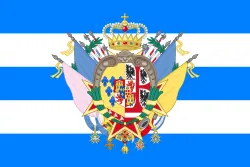
The Florentine state existed under several different political forms across seven centuries, each with its own flag and coat of arms.

.svg.png.webp)
.svg.png.webp)
Sources
- Kretschmer, K., Historische Geographie von Mitteleuropa, R. Oldenburg, Munich and Berlin 1904.
- Diaz, F., Il Granducato di Toscana — I Medici, Utet Libreria, Turin 1987.
- Droysen, G., Allgemeiner Historischer Handatlas, Velhagen & Klasing, Bielefeld and Leipzig 1886.
- Gamberini, A., A Companion to Late Medieval and Early Modern Milan, Brill, Leiden 2015.
- Gamberini, A. / Lazzarini, I., The Italian Renaissance State, Cambridge University Press, Cambridge 2012.
- Kleinhenz, C., Medieval Italy — An Encyclopedia, Routledge, New York 2004.
- Nolan, C.J., The Age of Wars of Religion, 1000–1650, Greenwood Press, Westport 2006.
- Phillips, C. / Axelrod, A., Encyclopedia of Wars, Facts On File, New York 2005.
- Procacci, G., History of the Italian People, Penguin Books, London 1973.
- Repetti, E., Dizionario geografico fisico storico della Toscana, Vol. 1–6, Florence 1833–1843.